YouTube is the world's second-largest search engine. Three billion monthly searches. Creators obsess over keywords, tags, thumbnails, and retention hacks trying to capture a slice of that traffic. But here's the brutal truth most SEO guides won't tell you: if your video metadata exists in only one language, you're invisible to roughly 95% of YouTube's search users. Not ranked low. Not on page two. Completely invisible. The search box returns results in the user's language. If your Russian-language title doesn't have a Portuguese equivalent, a Brazilian searching for your exact topic will never find you. Not because your content is bad. Because you never showed up.
The One-Language Search Ceiling
Let's visualise the problem. You make a video about smartphone photography tips. You optimise the Russian title, description, and tags beautifully. You rank on page one for several Russian search queries. Success, right? Sort of. You're now visible to roughly 150 million Russian speakers on YouTube. That sounds like a lot until you realise YouTube has 2.7 billion monthly active users. Your perfect SEO captured 5.5% of the platform. The other 94.5% of users cannot find you because their search results are served in their language.
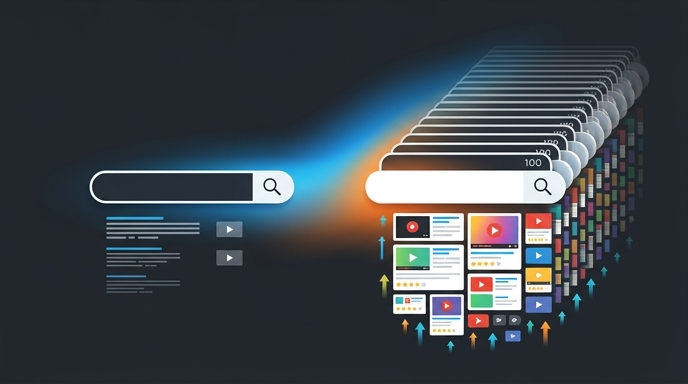
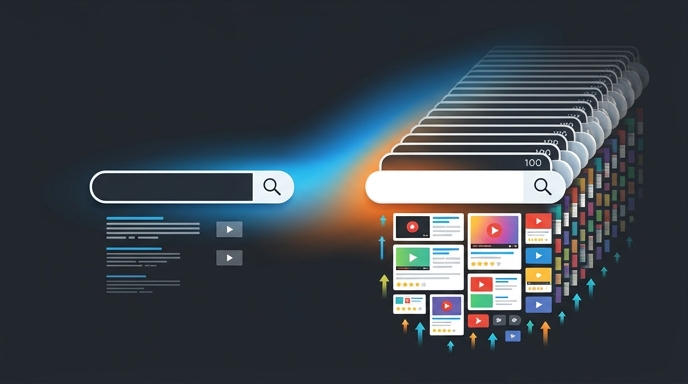
Now imagine that same video with translated titles and descriptions in Portuguese, Spanish, Indonesian, Turkish, Hindi, and 95 more languages. Suddenly, a Brazilian searching "dicas de fotografia com smartphone" can find you. An Indonesian searching "tips fotografi smartphone" can find you. A Turkish user searching "akıllı telefon fotoğrafçılık ipuçları" can find you. Same video. Same content. One hundred new doors you didn't have to build — just unlock.
Why Most YouTube SEO Advice Is Monolingual
Open any popular YouTube SEO guide. You'll find advice about keyword research tools, tag optimisation, and click-through rate hacks. Notice what's missing? Language strategy. The entire SEO industry operates on the assumption that you're optimising for one language. That assumption made sense when translation was slow and expensive. It makes zero sense now.
The biggest SEO gains available today aren't better keywords. They're new languages. A mediocre keyword in Portuguese will outperform a perfect keyword in Russian if the Portuguese market has lower competition. And in most niches, non-English markets are dramatically underserved. There are millions of search queries in Indonesian, Turkish, and Vietnamese with painfully few results. Your video could be the only one that answers those queries. That's not just SEO. That's a monopoly.
The Multilingual Metadata Advantage
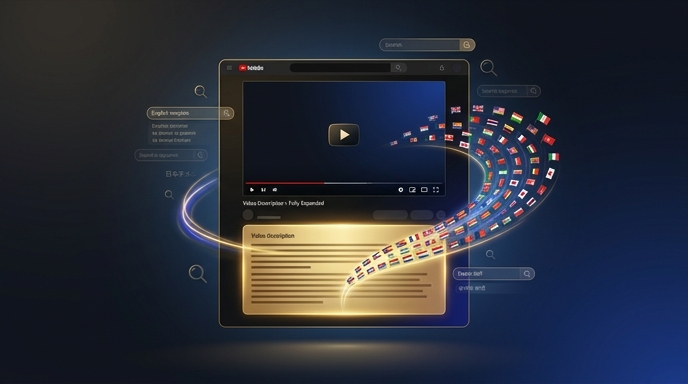
YouTube's search algorithm indexes your title and description in every language you provide. When you push translations through the API using VidLocalizer, YouTube treats each translated title as a legitimate search target for that language's queries. Your video now has 100+ searchable titles, each competing in a different language market.
Think about the math. One video. One hundred languages. If each language market has even a fraction of the search volume of your native language, your total addressable search traffic multiplies by orders of magnitude. The algorithm also factors subtitle availability into search rankings. A video with accurate Portuguese subtitles will outrank a video without them for Portuguese searches, all else being equal. You're not just adding accessibility. You're adding ranking power.
Real SEO Results From Translation
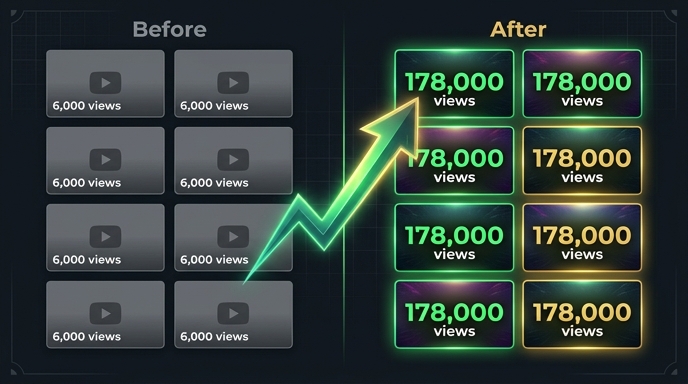
A tutorial channel I analysed had a video about fixing a specific laptop issue. Russian language only. It ranked decently for Russian searches and pulled about 400 views per month. The creator translated the title, description, and subtitles into 100+ languages through VidLocalizer. Three months later, YouTube Studio showed the video ranking for search terms in 14 languages. Monthly views jumped from 400 to 12,000. The content didn't change. The search surface area did.
Another creator in the cooking niche translated 20 recipes. Before translation, 90% of their search traffic came from Russian queries. After translation, Russian dropped to 40% of search traffic — but total search traffic quadrupled. Portuguese, Spanish, and Indonesian searches filled the gap. They didn't lose Russian rankings. They gained everything else.
Why VidLocalizer Beats Manual Translation for SEO
Manual translation is slow. Finding translators for 100 languages takes months and costs thousands. Even if you manage it, formatting subtitles and metadata for YouTube's API is a technical headache. VidLocalizer automates the entire pipeline. It translates, formats, and pushes everything through the API in minutes. Each language track is properly coded. Each title fits YouTube's character limits. Each description includes the right keywords.
The SEO impact compounds over time. Every new language is a new search market. Every new search market is a new source of views. Every new source of views signals to YouTube that your content has global appeal. Global appeal triggers broader recommendations. The flywheel spins itself.
Stop optimising for one language. Start optimising for the other 95% of YouTube. Your next viewer is searching for your content right now — in a language you haven't given them yet.
Localize your YouTube channel today
3-day free trial · 80+ languages · cancel any time